Upper Lower Split: A 4 Day Workout Plan for Lifters Over 40
An upper lower split trains your upper body one day and your lower body the next, four days a week. Every muscle gets worked twice a week, no session runs long, and your legs get a full rest day while your chest and back are working. For most lifters over 40 who can make four sessions a week, it is the best-balanced split there is.
Most people who come back to lifting start on three full-body days, and it works. Once four sessions a week is realistic, upper and lower is the natural next step: the sessions get shorter, your legs get a break between hard days, and the lifts keep moving. Here is how the split works and a plan you can start this week.
What is an upper lower split?
You divide your training into two kinds of days. Upper days cover chest, back, shoulders and arms. Lower days cover quads, hamstrings, glutes, calves and usually some core. You run each one twice a week, so a week looks like Upper A, Lower A, Upper B, Lower B, with the A and B days using different exercises or rep ranges so the same muscles get worked from a slightly different angle.
That twice-a-week rhythm matters. A 2016 meta-analysis on training frequency found that training a muscle at least twice a week built more muscle than hitting it once a week with a traditional "chest day, back day" routine. And a 2024 meta-analysis comparing split and full-body routines found no meaningful difference in strength or muscle growth when the weekly work was the same. So an upper lower split is not magic. It is simply an easy way to get the right amount of work, twice a week, without any single session dragging on.
Why an upper lower split works well after 40
- Shorter sessions. Four or five exercises a day instead of seven or eight. You finish while your form is still good.
- Built-in recovery. Your legs rest while you train your upper body and the other way round. Joints and tendons recover more slowly with age, and this gives them two or three days between hard sessions.
- Room to work around a sore joint. A cranky shoulder only affects two days a week, and the lower days carry on as normal.
- It fits the research on frequency. Four days a week, every muscle trained twice, is right in the range the frequency research supports.
A 4 day upper lower split workout plan
This is the plan I would hand a friend over 40. It uses mostly dumbbells, cables and machines with a couple of barbell lifts, and every movement has an easy swap if something hurts.
Upper A
| Exercise | Sets x reps | Easier on the joints |
|---|---|---|
| Dumbbell bench press | 3 x 8-12 | Neutral-grip dumbbell press or floor press |
| Chest-supported dumbbell row | 3 x 8-12 | Seated cable row |
| Landmine press | 3 x 8-12 | Incline dumbbell press |
| Lat pulldown | 3 x 10-12 | Neutral-grip pulldown |
| Hammer curl | 2 x 10-15 | Cable curl |
| Rope triceps pushdown | 2 x 10-15 | Band pushdown |
Lower A
| Exercise | Sets x reps | Easier on the joints |
|---|---|---|
| Goblet squat | 3 x 8-12 | Box squat to a bench, or leg press |
| Hip thrust | 3 x 8-12 | Glute bridge |
| Dumbbell step-up | 3 x 8-10 each leg | Lower box, or split squat holding a support |
| Lying leg curl | 3 x 10-12 | Seated leg curl |
| Seated calf raise | 2 x 12-15 | Standing calf raise |
| Farmer's walk | 2 x 30-45 s | Suitcase carry, one hand |
Upper B
| Exercise | Sets x reps | Easier on the joints |
|---|---|---|
| Incline dumbbell press | 3 x 8-12 | Low incline, neutral grip |
| One-arm dumbbell row | 3 x 8-12 | Chest-supported row |
| Side lateral raise | 3 x 12-15 | Cable lateral raise, smaller range |
| Wide-grip lat pulldown | 3 x 10-12 | Neutral-grip pulldown |
| Triceps pushdown | 2 x 10-15 | Band pushdown |
| Barbell curl | 2 x 10-12 | EZ-bar or dumbbell curl |
Lower B
| Exercise | Sets x reps | Easier on the joints |
|---|---|---|
| Single-leg Romanian deadlift | 3 x 8-10 each leg | Dumbbell Romanian deadlift, both legs |
| Leg press | 3 x 10-12 | Shorter range, feet higher on the platform |
| Stability ball hamstring curl | 3 x 10-12 | Lying leg curl |
| Standing calf raise | 3 x 12-15 | Seated calf raise |
| Cable wood chop | 3 x 10-12 each side | Pallof press |
Rest about two minutes between sets on the first two moves of each day and 60 to 90 seconds on the rest. Stop each set with one or two good reps left in you. You do not need to grind to failure to get stronger, and after 40 the cost of grinding shows up in your joints the next morning.
How to schedule your week
The classic layout is Monday and Tuesday on, Wednesday off, Thursday and Friday on:
| Mon | Tue | Wed | Thu | Fri | Sat | Sun |
|---|---|---|---|---|---|---|
| Upper A | Lower A | Walk | Upper B | Lower B | Walk | Rest |
Any order works as long as you keep the sequence (A, then B) and avoid two lower days back to back. If life gets in the way and you only make three sessions one week, just pick up the next session in the sequence. And if four days a week is not realistic right now, a 3 day full body workout gets you the same twice-a-week frequency on fewer days.
How to progress an upper lower split
Use double progression. Each exercise has a rep range, like 8 to 12. Keep the same weight until you can do the top of the range on every set, then add the smallest jump you can and drop back to the bottom of the range. With dumbbells that jump is often 5 pounds per hand, which is a big percentage on a light lift, so let the reps climb a little past the top of the range before you move up.
Every fourth to sixth week, take a deload week: same sessions, about half the sets, lighter weights. Recovery is where the strength actually gets built, and it takes longer after 40 than it did at 25.
Run this split without the spreadsheet
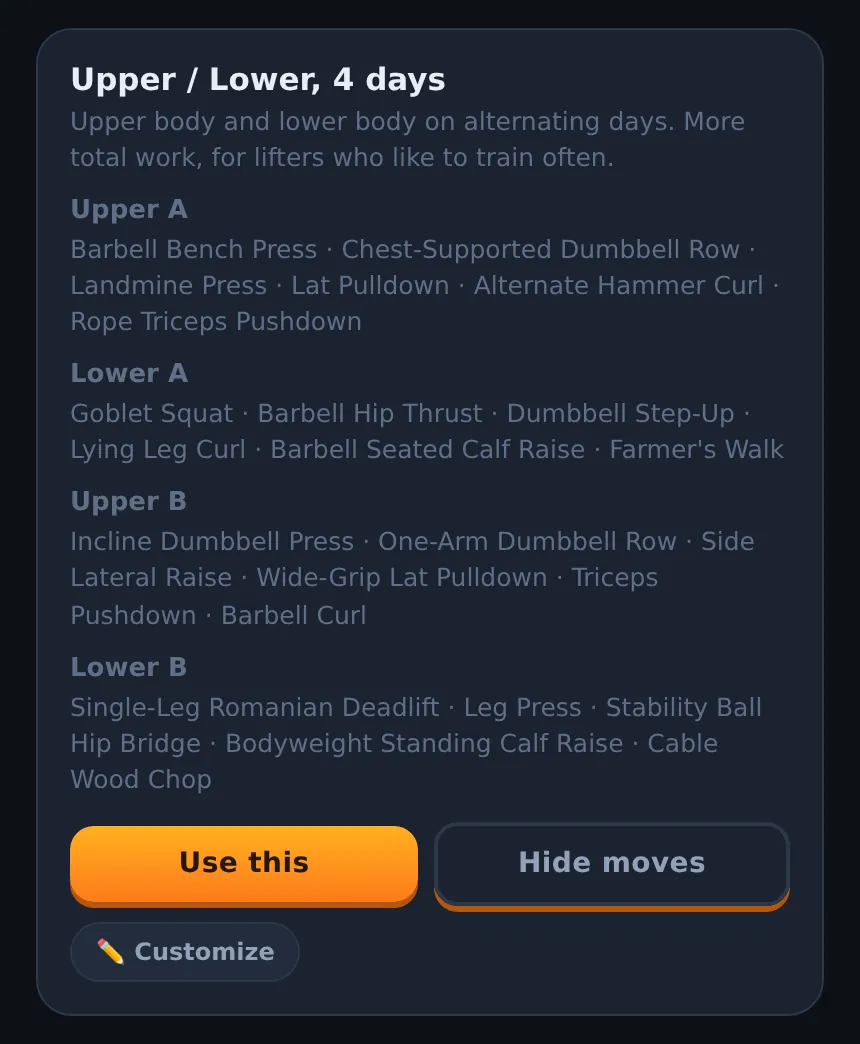
Liftspan has a free Upper / Lower, 4 days starter program. It is built for the room you train in, from a full gym to a pair of dumbbells at home, and anything that loads a joint you told it about never lands in it. Liftspan sets the weights, moves them up as you earn them and schedules your deload weeks. Switch to it or away from it any time and every weight you have worked up to comes with you.
Common questions
Is an upper lower split good for lifters over 40?
Yes, if you can train four days a week. It works every muscle twice a week, keeps each session short, and gives your legs and your upper body two or three days to recover between hard sessions, which matters more as you get older.
Is an upper lower split better than full body?
Not better, just different. A 2024 meta-analysis found no meaningful difference in strength or muscle growth between split and full-body routines when the weekly work was the same. Choose the one that fits your week: four days suits an upper lower split, two or three days suits full body.
How many exercises should an upper lower day have?
Four to six. Two or three main lifts for the big muscles, then one or two smaller moves for arms, calves or core. Past that, sessions run long and the quality of your sets drops.
Can I do an upper lower split three days a week?
You can alternate it, so one week is Upper, Lower, Upper and the next is Lower, Upper, Lower. It works, but each muscle only gets trained one and a half times a week on average. If you can only make three days, a full body routine is usually the simpler choice.
Sources: Schoenfeld, Ogborn & Krieger 2016, Effects of resistance training frequency on measures of muscle hypertrophy (Sports Medicine); Ramos-Campo et al. 2024, Efficacy of split versus full-body resistance training on strength and muscle growth (Journal of Strength and Conditioning Research); Grgic et al. 2018, Resistance training frequency and strength (Sports Medicine). General information, not a substitute for a clinician.
Keep reading: how many days a week to lift after 40 · what is a deload week? · 3 day full body workout · all guides