Deadlift Lower Back Pain: Causes, Fixes and Back-Friendly Alternatives
Lower back pain from deadlifts usually comes from a few fixable things: the bar drifting away from your legs, losing your brace at the bottom, pulling from a height your hips can't reach yet, or adding weight faster than your back could adapt. Fix those, lighten the load, and most lifters keep deadlifting. If the pain runs down your leg, comes with numbness or weakness, or is getting worse, stop and get it checked.
Most people who tweak their back on a deadlift do one of two things. They push through it, or they swear off deadlifts for good. Neither is usually the right call. The back is built to bend and lift, and done well, the deadlift is one of the best ways to make it stronger. Here is why it hurts, what to change, and which versions are easier on a cranky back.
Why deadlifts hurt your lower back
The lower back is the most commonly injured area in powerlifting. A 2024 systematic review in BMJ Open Sport & Exercise Medicine found the lower back and pelvis top the list, ahead of the shoulder and elbow. That doesn't mean the deadlift is dangerous. Injury rates in the review were low, roughly 1 to 4 injuries per 1,000 hours of training. It means that when something goes wrong in a heavy pull, the lower back is usually where you feel it.
The usual causes:
- The bar drifts forward. Every inch the bar moves away from your shins adds leverage your lower back has to fight.
- You lose your brace. The trunk stays stiff on the first rep, then softens as the set goes on and your back takes over from your hips.
- The bar starts too low for you. If your hips are stiff, pulling from the floor forces your back to round to reach the bar.
- You squat the weight up. Hips too low at the start turns the lift into a fight and puts the back in a poor position as the bar breaks the floor.
- Too much, too soon. Big jumps in weight, sets to failure, or going straight back to old numbers after a layoff. After 40, recovery is slower and this is the most common story.
- Grinding reps. The last slow, ugly rep of a heavy set is where form breaks down the most.
How to fix lower back pain from deadlifts
1. Keep the bar touching your legs
Start with the bar over the middle of your foot, about an inch from your shins. Drag it up your shins and thighs the whole way. If you finish with scuffed shins on a pair of sweatpants, you are doing it right. A bar that stays close keeps the load on your hips and legs instead of your lower back.
2. Brace before every rep
Take a big breath into your belly, tighten your stomach like someone is about to poke it, then pull. Reset your breath and brace again before each rep instead of bouncing through the set. Most back tweaks happen on a rep where the brace was missing.
3. Hinge, don't squat
The deadlift is a hip movement. Push your hips back, keep your shins fairly vertical, and think about pushing the floor away rather than lifting the bar. If your hips shoot up first when the bar leaves the floor, the weight is too heavy for now.
4. Raise the bar for a while
Pull from blocks, plates stacked under the bar, or the pins of a rack set just below the knee. A higher start means less hip flexibility is needed and less rounding to reach it. Lower it an inch at a time over a few weeks as the back settles.
5. Take weight off and earn it back
Drop 20 to 30 percent, stop each set with two or three reps left in the tank, and add weight in small steps. Fewer, cleaner sets beat a long grind. It feels like going backwards. It is how you are still deadlifting at 60.
6. Keep moving on the other days
The NHS advice for back pain is to stay active, and most back pain improves on its own within a few weeks. Bed rest tends to make it stiffer. Walk most days, keep training the parts that don't hurt, and come back to the hinge gradually.
Should you deadlift with lower back pain?
Often, yes, in a lighter form. A Swedish trial by Berglund and colleagues put 70 people with long-term mechanical low back pain on 8 weeks of either deadlift training or low-load motor control exercises. Pain improved in both groups by a similar amount. The people who did best with deadlifts had lower pain to start with and better back muscle endurance. The motor control exercises did better for day-to-day function.
The takeaway: deadlifting is not off the table with a sore back, but it isn't the right tool for everyone at every stage. If your pain is mild and your back is already reasonably strong, a lighter, well-braced deadlift can be part of getting better. If the pain is high, start with the gentler options below and build up.
Deadlift alternatives for a bad back
| Exercise | Why it is easier on the lower back |
|---|---|
| Trap bar deadlift | You stand inside the bar, so the load sits in line with your body instead of in front of it. A 2011 study of 19 powerlifters found lower peak load on the lumbar spine than a straight bar, and they lifted more weight with it |
| Block or rack pull | The same lift from a higher start, so less bending to reach the bar |
| Dumbbell Romanian deadlift | Lighter load, the weights hang by your sides, and you stop the range where it feels comfortable |
| Kettlebell deadlift from a box | A small, controllable load to relearn the hinge |
| Hip thrust or glute bridge | Trains the hips hard with your back supported on a bench or the floor |
| Cable pull-through | A hinge where the cable pulls you backward, not down |
| 45 degree back extension (bodyweight first) | Builds the back muscles' endurance, the same quality that predicted who did well in the Berglund trial |
None of these are a step down. Plenty of strong lifters never pull a straight bar from the floor again and do just fine. If your knees are the problem rather than your back, the trap bar loads them more, so lean on the hip thrust and Romanian deadlift instead.
When deadlift back pain means see someone
See a doctor or physiotherapist, rather than training through it, if you have:
- Pain, tingling or numbness that runs down one or both legs.
- Weakness in a leg or foot.
- Pain that is getting worse, keeps you awake, or hasn't improved after a few weeks of lighter training.
- A feeling of being unwell, a fever, or unexplained weight loss along with the pain.
Call emergency services straight away for numbness around your genitals or bottom, or new trouble controlling your bladder or bowels. Those are rare, but they are an emergency.
Keep training, around your back
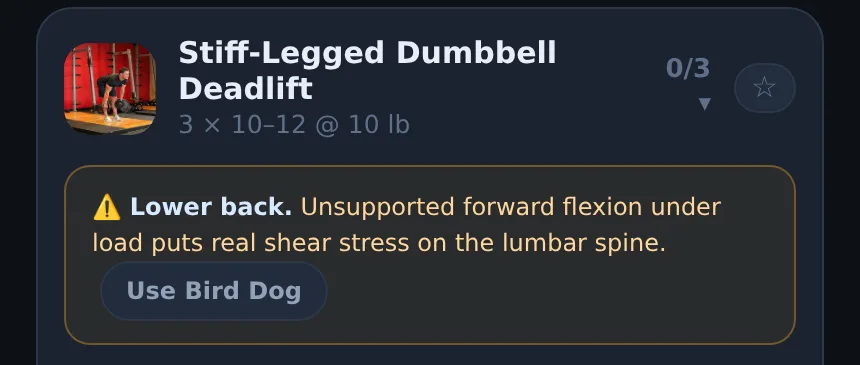
Tell Liftspan your lower back is a problem and it leaves loaded spinal flexion and unsupported bent-over work out of the plan it builds and every starter program, replaced with moves that train the same muscles. If a day has no core work, it opens with a stability move like a side plank, bird dog or dead bug. Build your own program with a deadlift in it and Liftspan marks it, names an alternative, and lets you decide. Your call.
Common questions
Why does my lower back hurt after deadlifts?
Most often the bar drifts away from your legs, you lose your brace partway through the set, the bar starts lower than your hips can reach without rounding, or the weight went up faster than your back could adapt. Keeping the bar close, bracing before every rep and lightening the load fixes a lot of it. Pain down the leg, numbness or weakness needs a doctor or physiotherapist.
Is it normal for your lower back to be sore after deadlifts?
Some muscle soreness across the lower back a day or two after heavy deadlifts is normal, especially if you are new to them. It should feel like the soreness in your legs after squats and fade within a few days. Sharp pain, pain in one spot, or pain that gets worse is not normal soreness.
Should I stop deadlifting if my back hurts?
Stop the version that hurts, not all hinging. Switch to a trap bar, pull from blocks, or use lighter dumbbell Romanian deadlifts, and keep the effort well short of failure. Research on people with long-term back pain found deadlift training helped about as much as gentler exercise, especially for those with lower pain and stronger backs.
Is the trap bar deadlift better for your back?
For most people, yes. Because you stand inside the bar, the load stays in line with your body. A study of powerlifters found lower peak load on the lower back with a trap bar than a straight bar, and they lifted more weight with it. It does load the knees a little more.
Using Liftspan? See how Liftspan works around your lower back in the help manual. New to it? Liftspan is a strength training app for lifters over 40 that builds your plan around your joints and moves the weight for you.
Sources: Injuries in weightlifting and powerlifting: an updated systematic review (BMJ Open Sport & Exercise Medicine, 2024); Berglund et al., Deadlift training for patients with mechanical low back pain (Umeå University); Swinton et al. 2011, A biomechanical analysis of straight and hexagonal barbell deadlifts (Journal of Strength and Conditioning Research); NHS, Back pain. General information, not a substitute for a clinician.
Keep reading: 3 day full body workout · what is a deload week? · all guides