Dumbbell Only Workout: A Full Body Plan for Lifters Over 50
A pair of dumbbells is enough to build real strength at any age. A dumbbell only workout covers every major muscle with squats, hinges, presses, rows and carries, it is easier on the joints than most barbell work, and it fits in a garage, a spare room or a hotel. Here is a full body plan for lifters over 50, and how to keep progressing when your dumbbells only go up in 5 pound jumps.
A set of adjustable dumbbells in the garage can be a whole gym. The limits are real, mostly around heavy leg work, but they are smaller than most people think, and the trade is a gym you can use at six in the morning without leaving the house.
Can you build muscle with only dumbbells?
Yes. Muscles grow from hard sets taken close to failure, done consistently and added to over time. They do not care whether the weight is a barbell, a machine or a dumbbell. The American College of Sports Medicine's 2026 resistance training position stand and the NSCA's position statement on older adults both emphasize regular training of the major muscle groups with gradual progression, not any particular piece of equipment.
You will lift less than you would with a barbell. In one study comparing chest presses, lifters could bench about 17 percent more with a barbell than with dumbbells, because each arm has to steady its own weight. That is fine. Your chest does not know what number is written on the weight, only how hard it is working.
Why dumbbells are good for lifters over 50
- Each joint finds its own path. A barbell locks both hands in place. Dumbbells let your wrists, elbows and shoulders move the way they want to, which is why they are the first swap for a shoulder that hurts on the bench.
- Both sides work equally. Your stronger side cannot quietly do more of the work.
- Single-leg work is easy to set up. Split squats, step-ups and single-leg deadlifts build leg strength and balance with far less load on your spine than a heavy barbell squat.
- They are always there. The best program is the one you do, and dumbbells at home remove the commute.
What you need
A set of adjustable dumbbells, or three or four pairs of fixed ones (for example 10, 20, 30 and 40 pounds), gets most people a long way. A flat or adjustable bench is very useful but not essential: without one, do floor presses and use a sturdy chair or step for step-ups.
A 3 day dumbbell only full body workout
Train on three non-consecutive days, such as Monday, Wednesday and Friday. If you have a pull-up bar at home, add pull-ups or assisted chin-ups to Day B.
Day A
| Exercise | Sets x reps | Easier on the joints |
|---|---|---|
| Goblet squat | 3 x 8-12 | Goblet box squat to a bench |
| Dumbbell floor press | 3 x 8-12 | Neutral grip (palms facing) |
| One-arm dumbbell row | 3 x 10-12 each arm | Chest-supported on an incline bench |
| Dumbbell Romanian deadlift | 3 x 8-12 | Shorter range, stop at mid-shin |
| Farmer's walk | 3 x 30-45 s | Lighter, shorter walks |
Day B
| Exercise | Sets x reps | Easier on the joints |
|---|---|---|
| Dumbbell reverse lunge | 3 x 8-10 each leg | Split squat, holding a support |
| Half-kneeling one-arm dumbbell press | 3 x 8-12 each arm | Incline dumbbell press if overhead work bothers your shoulder |
| Chest-supported dumbbell row | 3 x 10-12 | Lighter, pause at the top |
| Single-leg Romanian deadlift | 3 x 8-10 each leg | Hold something for balance |
| Side plank | 3 x 20-30 s each side | From the knees |
Day C
| Exercise | Sets x reps | Easier on the joints |
|---|---|---|
| Dumbbell step-up | 3 x 8-10 each leg | Lower step |
| Dumbbell bench press (or push-ups) | 3 x 8-12 | Hands-elevated push-ups |
| Dumbbell hip thrust or glute bridge | 3 x 10-15 | Bodyweight bridge |
| Side lateral raise | 2 x 12-15 | Smaller range, lighter |
| Hammer curl + overhead triceps extension | 2 x 10-15 each | Lying triceps extension if overhead bothers you |
Rest about two minutes after the first two exercises and 60 to 90 seconds after the rest. Stop each set with one or two good reps left in you. Only two days this week? Run Day A and Day B with an extra set on each exercise, the same way as the 2 day full body workout.
How to progress with dumbbells
The hard part with dumbbells is the jumps. Going from 15 to 20 pounds is a 33 percent increase, which nobody can do overnight. The answer is to let the reps do the climbing:
- Work in a rep range, such as 8 to 12.
- When you hit the top of the range on every set, try the next dumbbell up.
- If you cannot get at least the bottom of the range with it, stay on the lighter pair and keep adding reps, going a few past the top of the range, until the heavier pair is earned.
- Slow the lowering phase to three seconds, or pause at the bottom, to make a light weight harder in the meantime.
Every fourth to sixth week, take a lighter deload week with about half the sets.
A dumbbell plan that progresses itself
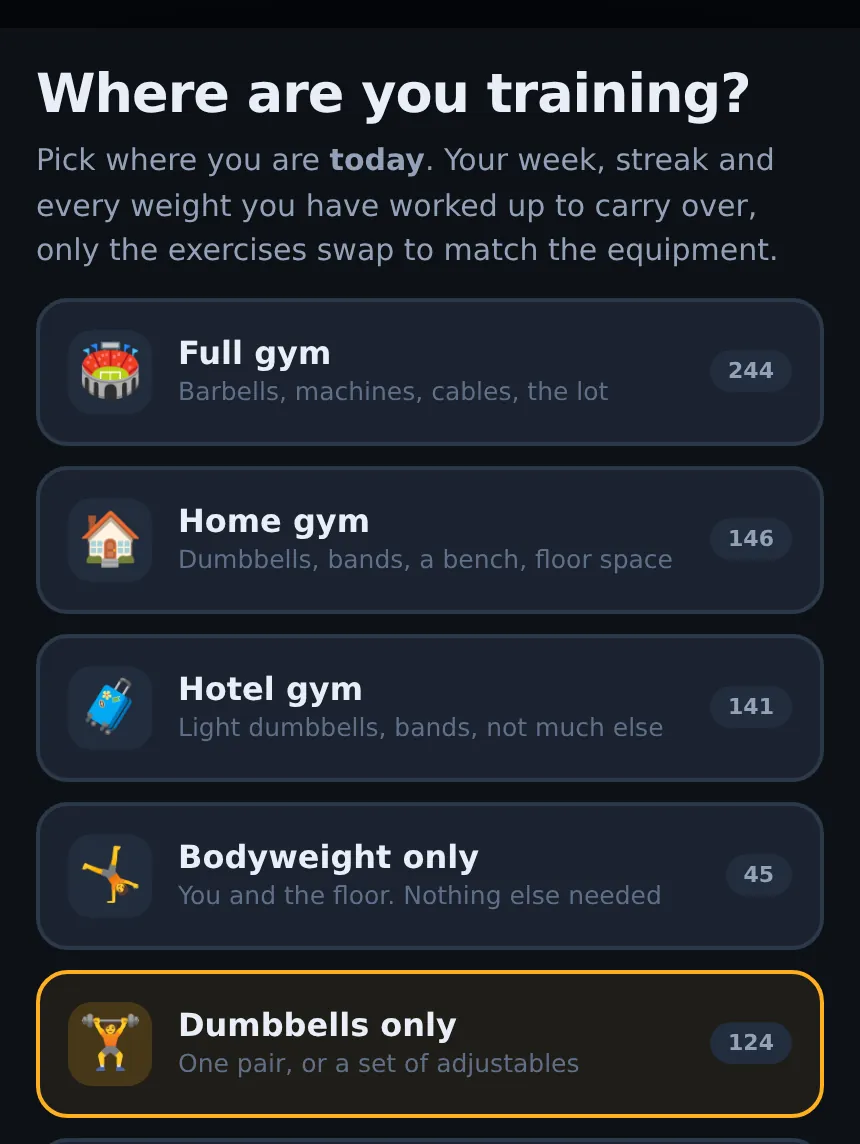
Choose Dumbbells only when you set up Liftspan and every workout is built from around 90 dumbbell and bodyweight moves, filtered around the joints you tell it about. When the next dumbbell is too big a jump, Liftspan holds the weight and lets your reps climb until it is earned, and it tells you so. Tell it the smallest jump your dumbbells allow, and it plans around that. The free starter programs, Full Body, 3 days, Busy Week, 2 days and Upper / Lower, 4 days, all work in a dumbbells-only room.
Common questions
Can you get strong with only dumbbells?
Yes. Muscles respond to hard, progressive work, not to a particular piece of equipment. You will lift less than with a barbell because each arm has to steady its own weight, but you can build real strength and muscle with dumbbells alone, at any age.
What weight dumbbells should a beginner over 50 start with?
Start with a weight you can lift for the top of your rep range with good form and two reps to spare. For many people that is 10 to 20 pounds for pressing and rows, and more for squats and deadlifts. Adjustable dumbbells, or a few fixed pairs, let you move up as you get stronger.
How many days a week should I do a dumbbell workout?
Two or three full body sessions a week, on non-consecutive days, is enough for most people over 50. That trains every muscle at least twice a week, with time to recover between sessions.
Can I train legs with only dumbbells?
Yes. Goblet squats, split squats, reverse lunges, step-ups and Romanian deadlifts build strong legs. Single-leg moves let a moderate dumbbell feel heavy, which is useful when your dumbbells top out.
Using Liftspan? See setting up a dumbbells-only plan in the help manual. New to it? Liftspan is a strength training app for lifters over 40 that builds your plan around your joints and moves the weight for you.
Sources: Saeterbakken, van den Tillaar & Fimland 2011, A comparison of muscle activity and 1-RM strength of three chest-press exercises with different stability requirements (Journal of Sports Sciences); ACSM 2026 resistance training position stand; NSCA, Resistance training for older adults (position statement, 2019). General information, not a substitute for a clinician.
Keep reading: 3 day full body workout · shoulder pain when bench pressing · all guides