Shoulder Pain When Bench Pressing: Causes, Fixes and Alternatives
Shoulder pain from bench pressing usually comes from a handful of fixable things: a grip that is too wide, shoulder blades that are not set, a bar that travels too deep, or weight that went up faster than the joint could adapt. Fix those and most people can keep pressing. If the pain is sharp, happens at night, or comes with weakness, stop and get it checked.
When the bench press starts to hurt, most people either push through it or quit benching altogether. Neither is usually right. Narrowing the grip, pulling the shoulder blades back and switching to dumbbells for a couple of months fixes it for a lot of lifters. Here is what the research says about why the bench bothers shoulders, and what to change.
Why the bench press hurts your shoulder
The shoulder is the most commonly injured area in people who lift weights. A review of resistance training injuries put it at roughly a third of all lifting injuries, and pointed to two broad causes: muscle imbalances, and technique. The bench press is where both tend to show up, because it loads the front of the shoulder hard at the bottom of the rep.
The most common culprits:
- A grip that is too wide. A wide grip lets you lift a little more, but it also puts more load through the front of the shoulder and the small joint at the top of it (the AC joint).
- Loose shoulder blades. If your shoulder blades drift up and forward as you press, the joint loses its stable base.
- Too much range. Letting the bar or dumbbells sink well below chest level stretches the front of the shoulder at its weakest point.
- Elbows flared straight out. Elbows at 90 degrees to your body, with the bar coming down near your neck, is a common pattern in people with sore shoulders.
- Too much, too soon. Muscles adapt faster than tendons. Big jumps in weight or sets are when pain tends to start, especially after 40.
- All push, no pull. Years of pressing without matching rows and pulldowns leave the upper back too weak to hold the shoulder in a good position.
How to fix shoulder pain on the bench press
1. Bring your grip in
A 2024 biomechanics study modeled shoulder loads across different bench techniques. Grips narrower than about 1.5 times shoulder width reduced the load on the AC joint and the shearing forces inside the shoulder, and reduced how hard the rotator cuff had to work. Wider grips increased all of them. For most people, that means hands just outside shoulder width, with forearms roughly vertical at the bottom.
2. Set your shoulder blades
The same study found that pulling your shoulder blades back and together (retraction) was protective. Before you unrack, squeeze your shoulder blades toward each other and down, as if putting them in your back pockets, and keep them there for the whole set.
3. Tuck your elbows a little
Aim for your elbows somewhere between 45 and 70 degrees from your body, with the bar touching around the bottom of your chest rather than up near your collarbones. In the 2024 model, elbow angle mattered less than grip width and shoulder blade position, so fix those two first.
4. Shorten the range for a while
A floor press stops the elbows at the floor, which caps how far the shoulder travels. A board press or pin press does the same with a barbell. Use a shorter range until the joint settles, then gradually work back to a full press.
5. Drop the weight and earn it back
Take 20 to 30 percent off, press with control, and stop each set with two reps in the tank. Then add weight in the smallest steps you can. It feels like going backwards. It is how you keep benching at 60.
6. Pull more than you press
For every set of pressing, do at least one set of rows or pulldowns, and add some face pulls or band pull-aparts. Reviews of conservative care for shoulder pain keep finding that strengthening the muscles around the joint beats resting it.
Bench press alternatives for bad shoulders
| Exercise | Why it is easier on the shoulder |
|---|---|
| Neutral-grip dumbbell press | Palms facing each other keeps the elbows tucked, and each arm finds its own path |
| Dumbbell floor press | The floor stops the elbows before the shoulder reaches its most stretched position |
| Low incline dumbbell press | A slight incline changes the angle many sore shoulders prefer |
| Landmine press | Presses in an arc rather than straight up, which most shoulders tolerate well |
| Push-ups (hands elevated if needed) | Your shoulder blades move freely, unlike on a bench |
| Machine chest press | A fixed path you can load lightly and progress in small steps |
None of these are consolation prizes. You can build a strong chest and strong triceps without ever touching a barbell again, and plenty of lifters do. The bad shoulder guide covers the rest of the week: which other lifts to swap and how to progress around a cranky joint.
When shoulder pain means see someone
Get it checked by a doctor or physiotherapist, rather than training through it, if you have:
- Sharp or stabbing pain during the lift, not just effort.
- Pain at night, or pain that wakes you up.
- Weakness, like struggling to lift your arm out to the side.
- Pain that has not improved after two or three weeks of lighter, modified training.
- Numbness or tingling down the arm, or a pop at the time of injury.
Keep pressing, around your shoulder
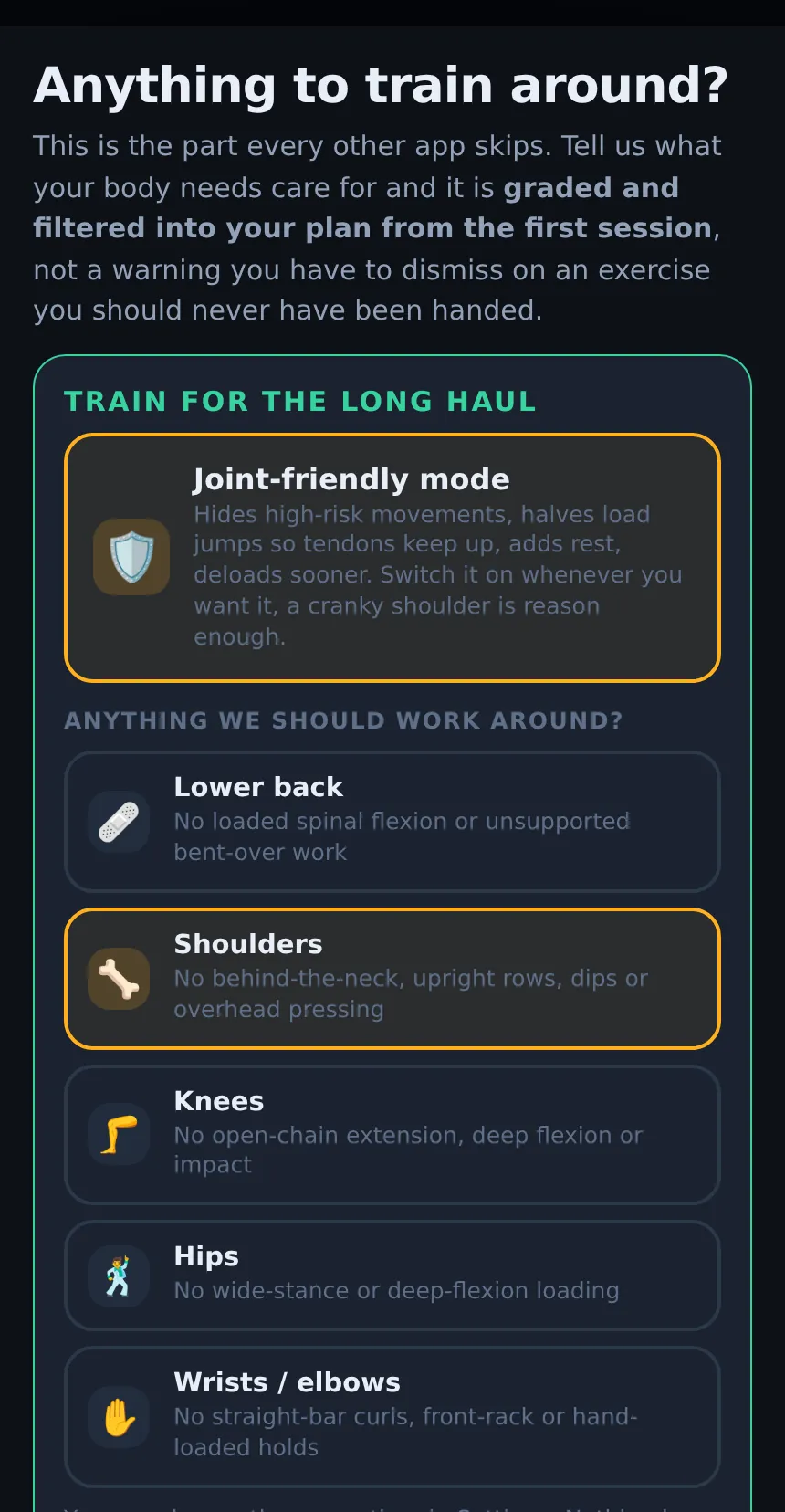
Tell Liftspan your shoulders are a problem and it stops programming overhead pressing, dips, upright rows and behind-the-neck work, in the plan it builds and in every starter program. In the plan it builds, chest days also lean on neutral-grip dumbbell presses and push-up variations instead of the flat bench, and a move that works the shoulder never opens a session. Tap Swap (part of Pro) to trade any move for another that suits your equipment and joints, with your weight carried across. Or build your own program with the bench in it once your shoulder settles, and Liftspan still coaches it.
Common questions
Why does my shoulder hurt when I bench press?
Most often it is a grip that is too wide, shoulder blades that are not pulled back, a bar that sinks too deep, or weight that went up faster than your shoulder could adapt. Narrowing your grip and setting your shoulder blades fixes a lot of it. Sharp pain, night pain or weakness needs a doctor or physiotherapist.
Should I stop bench pressing if my shoulder hurts?
Stop the version that hurts, not all pressing. Switch to a neutral-grip dumbbell press or a floor press, lower the weight, and keep training the muscle through a range that does not hurt. Complete rest usually leaves the shoulder weaker, not better.
What grip width is best for sore shoulders?
Hands just outside shoulder width, with forearms roughly vertical at the bottom. A 2024 biomechanics study found that grips narrower than about 1.5 times shoulder width reduced the load on the shoulder compared with wider grips.
Are dumbbells better than a barbell for shoulder pain?
For many people, yes. Dumbbells let each arm find its own path and allow a neutral grip, and you can stop the range where it feels comfortable. You will lift less weight in total, but your chest gets a similar workout.
Using Liftspan? See how Liftspan works around a sore shoulder in the help manual. New to it? Liftspan is a strength training app for lifters over 40 that builds your plan around your joints and moves the weight for you.
Sources: Noteboom et al. 2024, Effects of bench press technique variations on musculoskeletal shoulder loads and potential injury risk (Frontiers in Physiology); Kolber et al. 2010, Shoulder injuries attributed to resistance training: a brief review (Journal of Strength and Conditioning Research); JOSPT, conservative physical therapy for subacromial shoulder pain (systematic review). General information, not a substitute for a clinician.
Keep reading: lifting with a bad shoulder · upper lower split · dumbbell only workout · all guides