What Is a Deload Week? How Often to Deload and Why It Works
A deload is a planned easy week. You keep training, or you take the week off, but either way you do a lot less, on purpose, so the fatigue you have been piling up can drain away. You come back feeling stronger, and after 40 it is one of the most useful habits you can build.
For years I thought deloads were for people who were not serious. Then I hit my 50s and spent a few months grinding the same weights into the ground, feeling worse every week. One easy week fixed what two months of pushing had not. Here is how they work.
What is a deload week?
In 2023, researchers asked an international panel of strength and physique coaches to agree on the basics. Their consensus definition: a deload is a period of reduced training stress designed to lower physical and mental fatigue, help recovery, and set you up for the next block of training.
The same panel's typical practice looked like this:
- How often: generally every 4 to 6 weeks, adjusted to how you are responding.
- How long: usually about a week.
- What changes: volume comes down, through fewer sets, fewer reps, or fewer sessions. The weight on the bar can stay about the same if the volume drops enough.
Two ways to deload
| Option | What you do | Good for |
|---|---|---|
| Lighter week | Same sessions and exercises, roughly half the sets, stop well short of failure. Keep the weights about where they were, or a little lighter. | Keeping the rhythm of the week and the feel of the lifts |
| Week off | No lifting at all for the week. Walk, stretch, sleep. | Busy weeks, travel, beat-up joints, or when you just need a break |
Both work. A week off will not cost you strength: for trained lifters, strength holds up for a week or two, and what fades after a longer break comes back about twice as fast. Pick the one you will actually do.
Signs you need a deload week sooner
- Weights that used to move easily feel heavy for more than a session or two.
- Joints ache the morning after, rather than muscles.
- Sleep gets worse, or you feel flat all day.
- You start dreading sessions you usually enjoy.
One bad day is just a bad day. A week of them is fatigue talking, and a deload is how you listen.
Why deloads matter more after 40
Fatigue builds up faster than fitness, and recovery gets slower with age. At 25 you can often push through months of hard training and get away with it. At 55, tendons and joints complain first, and a lot of what gets called an injury is really accumulated fatigue that never got a chance to clear. A planned easy week every month or so is cheap insurance. It is also why the number of days you lift matters less than whether you recover between them.
What to do during a deload week
Keep moving. A deload is time off from hard lifting, not time off from being active. Walk most days, do some mobility work, and get to bed on time. It also protects the thing that matters most over the long run, the daily habit of showing up. A deload week where you still walk every day is a week the habit got stronger, not weaker.
Deloads, planned for you
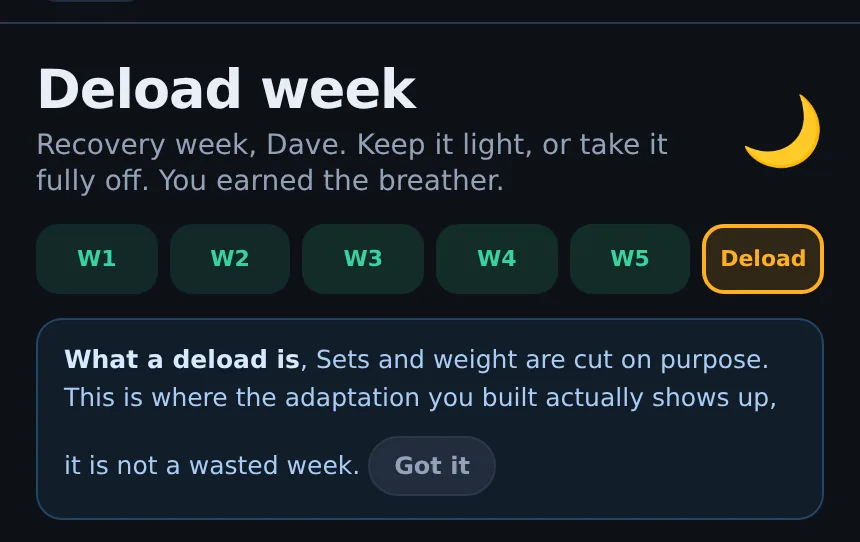
Liftspan builds a deload into every training block, every fourth week in joint-friendly mode (on by default from age 50) and every sixth otherwise, so you do not have to remember when you are due. When the week comes, the app trains you light automatically, and on Pro you can take the whole week off instead. Either way the week counts, and your daily streak keeps going as long as you log a walk or anything else. After a deload, the weights pick up right where your progress left them.
Common questions
What is a deload week?
A deload week is a planned period of easier training, usually about a week long, designed to reduce fatigue and help you recover so the next block of training goes better. Most often you cut the number of sets and reps while keeping the weights about the same, or you take the week off entirely.
How often should I deload?
A panel of strength and physique coaches agreed that deloads are generally taken every 4 to 6 weeks, adjusted to how you are responding. If you are over 40 or recovering slowly, lean toward the more frequent end, and take one early if you see signs of fatigue building.
Will I lose strength during a deload?
No. A week of easier training, or even a week off, is not long enough to lose meaningful strength for a trained lifter. Most people come back feeling stronger because the fatigue has cleared.
Should I still exercise during a deload week?
Yes, just not hard. Walking, mobility work and light activity help you recover and keep your exercise habit going. Save the heavy lifting for the week after.
Sources: Bell et al. 2023, Integrating deloading into strength and physique sports training: an international Delphi consensus (Sports Medicine Open). General information, not a substitute for a clinician.
Keep reading: the science of training after 40 · how many days a week to lift after 40 · does walking build muscle? · all guides