How Many Days a Week Should You Lift Weights After 40?
Two or three. For most people over 40, two or three strength sessions a week, with every major muscle trained at least twice, is enough to keep getting stronger. Past that, extra days mostly buy you fatigue, and fatigue is the thing that ends training careers at our age.
I am in my late 50s and I have run every schedule there is, including the five-day split I copied out of a magazine at 25. What keeps me training now is a lot less time in the gym than I used to spend, and the research backs up why that works.
The short answer, by schedule
| Days a week | Who it fits | How to lay it out |
|---|---|---|
| 2 | Busy weeks, beginners, anyone coming back from a break | Two full-body sessions, at least two days apart (Mon and Thu) |
| 3 | The sweet spot for most lifters over 40 | Three full-body sessions with a rest day between each (Mon, Wed, Fri) |
| 4 | Experienced lifters with time and good recovery | Upper and lower split, each twice (Mon upper, Tue lower, Thu upper, Fri lower) |
Every row trains each muscle about twice a week. That is the part that matters, not the number of days on the calendar.
How often should you lift weights? What the research says
The American College of Sports Medicine's 2026 resistance training position stand recommends training all the major muscle groups at least twice a week, and around 10 hard sets per muscle per week if building muscle is the goal. The NSCA's position statement on older adults lands in the same place: two to three times per week, per muscle group.
More days is not automatically better. A meta-analysis of 22 studies on training frequency and strength found that lifting more often only helped because it added more total work. When the total number of sets was matched, frequency on its own made no meaningful difference to strength gains. The same review found older adults did not get extra benefit from higher frequencies at all.
Put simply: get your weekly sets in, spread across at least two sessions per muscle, and pick the number of days that lets you do that without dragging.
Why recovery sets the limit after 40
The work you do in the gym is the signal. The getting stronger happens while you recover from it. At 25 you can get away with thin recovery. At 55, sleep, joints and tendons set the ceiling long before muscles do, which is why the science of training after 40 looks different from the advice written for college athletes.
Signs you are training more often than you are recovering:
- The same weights feel heavier week to week instead of lighter.
- Joints ache the next morning rather than muscles.
- You sleep worse on training nights.
- You start dreading sessions you used to look forward to.
Any of those is a reason to drop a day, not add one. If a joint is the one complaining, train around it rather than through it.
Full body or a split?
On two or three days a week, full-body sessions are the simplest way to hit every muscle twice. Each session has one push, one pull, one leg movement, and something for the core. On four days, an upper and lower split does the same job with shorter sessions. Body-part splits (chest day, back day, leg day) only train each muscle once a week unless you lift five or six days, which is exactly the schedule most people over 40 cannot recover from.
What to do on the other days
Not lifting is not the same as doing nothing. The days between sessions are for moving: a walk, a bike ride, some mobility work on the floor. It keeps you loose, it keeps the daily exercise habit alive, and it helps you recover rather than getting in the way of it.
That gives you a week with two habits: strength two or three times, movement every day. The daily one keeps you showing up. The weekly one is where you get stronger.
When to do fewer days
Some weeks two days is the right answer even for an experienced lifter: travel, a work crunch, a cold, a joint that needs a few days. Two good sessions beat three bad ones. And every four to six weeks or so, most lifters do best with a planned easier week, a deload, where the work drops off so the fatigue can drain before the next block.
Let the app pick the days for you
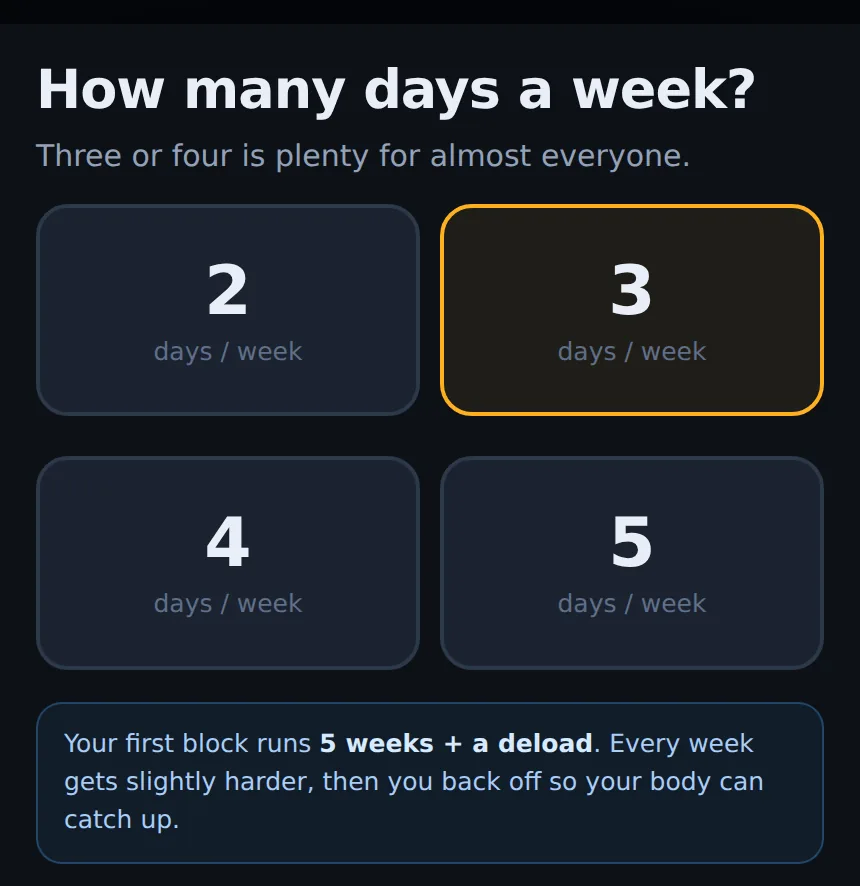
Tell Liftspan how many days a week you can train, anywhere from two to five, and it lays out the week for you, with the weight moving up only when you have earned it. Miss a session and the week still advances without piling the missed work on top. The days in between count too: log a walk and your daily streak stays lit.
Common questions
Is lifting two days a week enough after 40?
For many people, yes. Two full-body sessions a week train every major muscle twice, which meets the ACSM's minimum and the NSCA's recommendation for older adults. Three days gives you more room to spread the work out, but two consistent days beats three you keep missing.
Can I lift weights every day after 40?
You can, but most people over 40 recover better with rest days between hard sessions for the same muscles. Research on training frequency finds that the total amount of work matters more than how many days you spread it over, so lifting every day mostly adds fatigue. Move every day instead, and lift two to four days.
Should I do full-body workouts or a split?
On two or three days a week, full-body sessions are the simplest way to train each muscle twice. On four days, an upper and lower split works well. Classic body-part splits only hit each muscle once a week unless you train five or six days.
How long should each session be?
Most full-body sessions land between 40 and 60 minutes, including a short warm-up. Longer is not better if it means you skip the next one.
Sources: ACSM 2026 resistance training position stand · NSCA, Resistance training for older adults (position statement, 2019) · Grgic et al. 2018, Resistance training frequency and strength (Sports Medicine). General information, not a substitute for a clinician.
Keep reading: the science of training after 40 · how to build an exercise habit that sticks · all guides