Landmine Press: How to Do It, Muscles Worked, and Why Shoulders Like It
The landmine press is a shoulder press where one end of a barbell is anchored to the floor and you press the other end up and forward in an arc. Because the bar travels in front of you instead of straight overhead, many lifters whose shoulders complain about overhead pressing can do it comfortably. It trains the shoulders, upper chest and triceps, and your core works hard to keep you steady.
What is a landmine press?
A landmine is a pivot that holds one end of a barbell on the floor. Many gyms have one bolted to a rack or a base plate. If yours doesn't, wedge the end of the bar into a corner of the room, with a towel wrapped around it to protect the wall. Load plates on the free end, pick it up at shoulder height, and press.
The bar can only move in an arc around the pivot. That fixed arc is the whole point: it guides the press up and forward, at an angle somewhere between a bench press and an overhead press.
How to do a landmine press
- Set up. Stand facing the loaded end of the bar, feet about hip width apart. Hold the end of the bar at shoulder height with both hands, elbows tucked in front of your body.
- Brace. Squeeze your glutes, tighten your stomach and stand tall. Your ribs stay down for the whole set.
- Press up and forward. Push the bar up and away until your arms are straight. Let your shoulder blades move forward a little at the top. Don't lean back to finish the rep.
- Lower under control. Bring the bar back to your upper chest along the same arc, then press again.
For the single-arm landmine press, hold the end of the bar in one hand at your shoulder and stand in a split stance, with the opposite foot forward. Press without twisting or leaning, finish the set, then switch sides. It's harder on your core and shows quickly if one side is weaker.
Muscles worked
The landmine press mainly trains the front of the shoulders, with the upper chest and triceps doing a lot of the work. Because you press standing, your core, glutes and legs hold you steady, and the single-arm version adds a real anti-rotation challenge for your midsection. The muscles around your shoulder blades get worked too, because the arc lets the blades move forward and upward as you press, as they naturally want to.
Why the landmine press is easier on your shoulders
Strict barbell overhead pressing is one of the lifts most likely to aggravate a cranky shoulder, which is why it tops the list in our bad shoulder guide. The landmine press changes three things:
- The angle. You press up and forward, not straight overhead, so the arm never has to reach the end of its overhead range.
- The grip. Your palms face each other or slightly inward, which keeps the elbows in front of the body rather than flared out to the sides.
- The shoulder blades. They're free to move with the arm instead of being pinned against a bench.
That's why it is the press Liftspan reaches for when it swaps out an Arnold press or a machine shoulder press. Easier on the shoulder isn't the same as painless for everyone, though. If it pinches, shorten the range or lighten the load, and if pain is sharp or spreading, get it checked.
Landmine press vs overhead press
| Landmine press | Barbell overhead press | |
|---|---|---|
| Bar path | An arc, up and forward | Straight up, overhead |
| Shoulder range | Stops short of full overhead | Full overhead |
| Main muscles | Front shoulders, upper chest, triceps | Shoulders, triceps, upper back |
| Core demand | High, very high single-arm | High |
| Equipment | One barbell and a landmine or a corner | Barbell and a rack |
| Best for | Cranky shoulders, lifters over 40, building pressing strength around a sore joint | Full overhead strength when your shoulders are happy with it |
Landmine press variations
| Variation | What changes |
|---|---|
| Two-hand landmine press | The easiest to learn and the heaviest you'll lift. Start here |
| Single-arm landmine press | One side at a time, standing in a split stance. More core work |
| Half-kneeling landmine press | One knee down. You can't cheat with your legs or lean back, so it's the strictest version |
| Landmine push press | A small dip and drive with the legs to move more weight. For when the strict version feels easy |
Common mistakes
- Leaning back. Arching to finish the press turns it into a standing incline bench and loads the lower back. Ribs down, glutes tight.
- Elbows flared out. Keep them in front of your body, not out to the sides.
- Starting too heavy. The bar's own weight plus the leverage of the arc makes small plates feel heavier than you expect. Start with the bar alone.
- Twisting on single-arm presses. If your torso rotates, the weight is too heavy or your stance is too narrow.
Sets, reps and where it fits
Use 3 sets of 8 to 12 reps for the two-hand version, or 3 sets of 8 to 10 per side single-arm, stopping each set with a rep or two left. Add weight in the smallest steps you can, which on a landmine usually means 2.5 lb or 1.25 kg plates. It fits as the vertical push in a 3 day full body workout or on the upper days of an upper lower split.
A 3 day landmine press plan
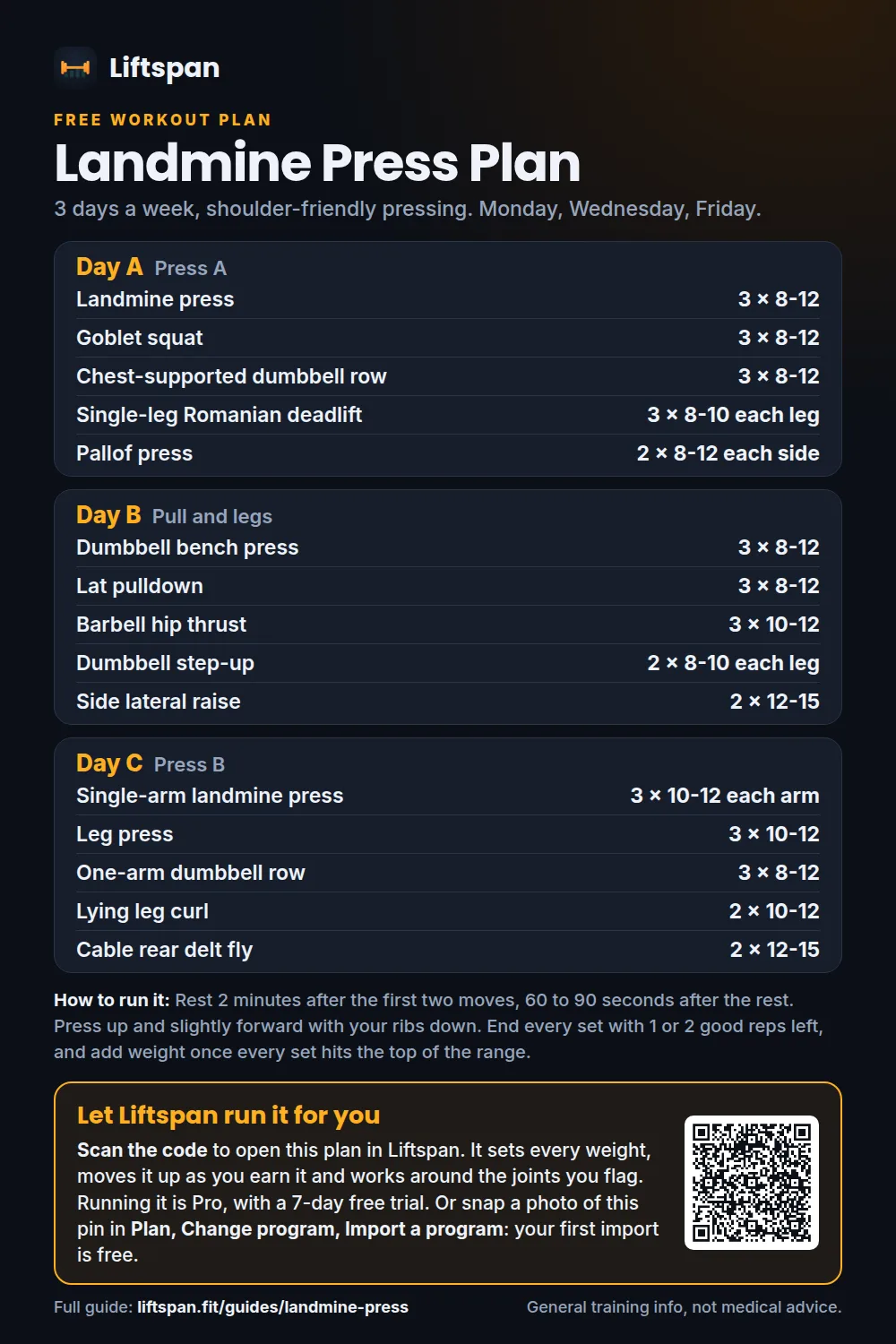
Here is a full week built around the lift: the two-hand landmine press on day A, the single-arm version on day C, with rows, legs and core around them and no barbell overhead pressing. Run it Monday, Wednesday and Friday.
| Day | Exercise | Sets x reps |
|---|---|---|
| Day A Press A | Landmine press | 3 x 8-12 |
| Goblet squat | 3 x 8-12 | |
| Chest-supported dumbbell row | 3 x 8-12 | |
| Single-leg Romanian deadlift | 3 x 8-10 each leg | |
| Pallof press | 2 x 8-12 each side | |
| Day B Pull and legs | Dumbbell bench press | 3 x 8-12 |
| Lat pulldown | 3 x 8-12 | |
| Barbell hip thrust | 3 x 10-12 | |
| Dumbbell step-up | 2 x 8-10 each leg | |
| Side lateral raise | 2 x 12-15 | |
| Day C Press B | Single-arm landmine press | 3 x 10-12 each arm |
| Leg press | 3 x 10-12 | |
| One-arm dumbbell row | 3 x 8-12 | |
| Lying leg curl | 2 x 10-12 | |
| Cable rear delt fly | 2 x 12-15 |
Rest 2 minutes after the first two moves, 60 to 90 seconds after the rest. Press up and slightly forward with your ribs down. End every set with 1 or 2 good reps left, and add weight once every set hits the top of the range.
Pressing, around your shoulders
Open this plan in Liftspan and it is ready to go: every move fitted to your gym and to any joint you flag, every weight filled in and moved up as you earn it, and a lighter deload week at the end of each block. Running it is Pro, with a 7-day free trial. Rather use paper? Print the sheet, or snap a photo of it in Liftspan: your first import is free.
Common questions
What does the landmine press work?
Mainly the front of the shoulders, the upper chest and the triceps. Because you press standing, your core, glutes and legs work to keep you steady, especially in the single-arm version.
Is the landmine press good for bad shoulders?
For many people, yes. The bar moves up and forward in an arc instead of straight overhead, your grip keeps your elbows in front of you, and your shoulder blades can move freely. It is not painless for everyone, so start light and stop if it pinches.
Can you do a landmine press without a landmine?
Yes. Wedge one end of a barbell into the corner of a room, with a towel around it to protect the wall, and load the other end. It works the same way.
Is the landmine press a shoulder or chest exercise?
Both. The angle sits between an overhead press and an incline bench press, so it trains the front of the shoulders and the upper chest together, with the triceps helping.
How heavy should a landmine press be?
Start with the empty bar. The leverage of the arc makes the end of the bar feel heavier than its weight on a scale. Add small plates when you can do every set of 12 with good form.
Using Liftspan? See how Liftspan works around a sore shoulder in the help manual. New to it? Liftspan is a strength training app for lifters over 40 that builds your plan around your joints and moves the weight for you.
Keep reading: lifting with a bad shoulder · shoulder pain when bench pressing · all guides