Does Walking Build Muscle? What Walking Does (and Doesn't Do) After 40
Not much, once you can walk comfortably. Walking is the best daily exercise habit there is: easy to start, easy to repeat, and it counts toward the guidelines. What it will not do on its own is build muscle or keep you strong. After 40, the winning combination is simple: walk most days, and lift two or three.
I walk nearly every day and lift three times a week. The walk is what keeps me showing up on the days I do not feel like doing anything. The lifting is what keeps me strong enough to carry the groceries, the luggage and eventually the grandkids. Here is what each one actually does for you.
What walking does well
It counts toward the guidelines. The CDC recommends adults get at least 150 minutes a week of moderate activity, and it names brisk walking as the example. Thirty minutes, five days a week, and you are there.
More steps are linked to a longer life, up to a point. A meta-analysis of 15 studies and nearly 50,000 people found that for adults 60 and older, the lower risk of early death associated with more daily steps leveled off at around 6,000 to 8,000 steps a day. For adults under 60 it leveled off at about 8,000 to 10,000. So you do not need 10,000 steps to get most of the benefit, especially past 60.
It is the easiest habit to keep. No gear, no gym, no warm-up. That is exactly why it works as the daily anchor for an exercise habit that sticks.
It helps you recover. An easy walk the day after a hard strength session gets you moving without asking your muscles for more.
Why walking does not build much muscle
Walking is something your legs already do all day, so it does not ask them for much more than they can already handle. That means it does little to build strength or muscle once you can walk comfortably. And muscle is the thing we lose from our 40s onward if we do not train it.
A large study of 3,477 adults in Korea makes the point well. People who walked at least five days a week had better bone density and muscle than people who did not. But the combination that was linked to preventing the loss of both bone and muscle together was walking plus resistance exercise at least two days a week. Walking helps. Walking plus lifting helps a lot more.
How to make your walks count
- Walk briskly. Fast enough that you can talk but not sing. That is moderate intensity, the kind the guidelines count.
- Find a hill. Hills and stairs ask more of your legs and your heart than flat ground does.
- Aim for a step range, not a magic number. If you are over 60, 6,000 to 8,000 a day is a good target. Under 60, 8,000 to 10,000. Build up to it.
- Hang it on something you already do. After coffee, after dinner, while you take a phone call. A walk with a fixed time slot happens. A walk you will fit in somewhere does not.
Walk most days, lift two or three
The week that works for most people over 40 has two habits in it. Move every day: a walk, a ride, some mobility work. And strength train two or three days a week, every major muscle at least twice. Here is how to lay those strength days out.
On lifting days, the walk can be short or skipped. On the days in between, it is the main event. And on a week off from lifting, keep walking. Your strength will hold up fine for a week or two, and it comes back faster than it fades, but the daily habit is harder to restart than it is to keep.
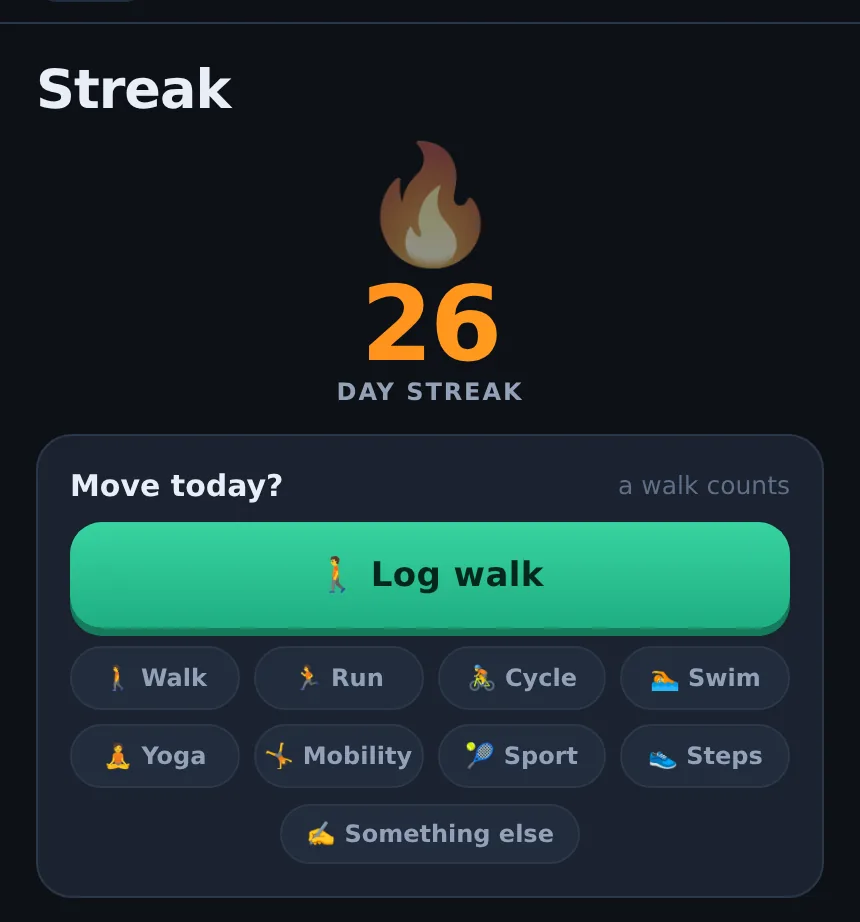
A walk keeps the streak lit
In Liftspan, a walk counts. Log it with one tap and your daily streak stays alive, and your lifting days count on their own. It never pretends a walk was a workout, though: your strength numbers only move when you actually lift. Walk most days, lift two or three, and the app keeps score of both.
Common questions
Does walking build muscle?
Not much, once you can walk comfortably. Walking is good for your heart, your mood and your habit, but building or keeping muscle takes resistance training: weights, bands or bodyweight exercises that challenge the muscle more than daily life does.
Is walking enough exercise after 40?
Walking is enough to meet the aerobic part of the guidelines if you do about 150 minutes a week at a brisk pace. It is not enough on its own to keep your muscles strong. The CDC also recommends muscle-strengthening activity at least two days a week, so pair your walks with two or three short strength sessions.
How many steps a day should I aim for after 60?
In a large meta-analysis of daily steps, the lower risk of early death linked to more steps leveled off at around 6,000 to 8,000 steps a day for adults 60 and older, and around 8,000 to 10,000 for younger adults. If you are well below that, add steps gradually.
Should I walk on my rest days from lifting?
Yes. An easy or brisk walk on a rest day helps you recover and keeps your daily habit going without adding the kind of fatigue a hard session would. Save the hard efforts for your strength days.
Sources: CDC physical activity guidelines for adults · Paluch et al. 2022, Daily steps and all-cause mortality (Lancet Public Health) · Daily walking with intermittent resistance exercise and osteosarcopenia (KNHANES cohort). General information, not a substitute for a clinician.
Keep reading: how to build an exercise habit that sticks · how many days a week to lift after 40 · all guides