How to Make Exercise a Habit That Actually Sticks
Most people do not quit exercising because they are lazy. They quit because they set the bar at a full workout, miss a day, decide the streak is broken, and stop. A habit that lasts is built the other way around: a bar low enough to clear on your worst day, a cue you already have, and a plan for the day you miss.
I am in my late 50s and I have started and stopped more fitness routines than I can count. The ones that stuck all had the same shape, and it turns out the research agrees with it. Here is what actually builds the habit, and what quietly kills it.
How long it takes to make exercise a habit
You have probably heard 21 days. It comes from a 1960s self-help book, not from a study. When researchers at University College London tracked 96 people building a new daily habit, the median time for it to feel automatic was 66 days, and the range ran from 18 days to 254. Simple habits got there faster. Harder ones took longer.
A study of new gym members landed in the same place for exercise: people who trained at least four times a week for about six weeks built the habit, and the strongest predictor was not intensity or motivation. It was consistency.
So give it two or three months, not three weeks. The good news hides in the same UCL study: missing a single day did not derail the habit. What matters is the pattern over weeks, not a perfect record.
Set the bar low enough to clear on a bad day
The same gym study found that keeping things simple predicted a habit almost as strongly as consistency did. That is the whole trick. If the daily minimum is a 60-minute workout, you will clear it on your good days and fail it on the rest, and every failure teaches your brain that this is something you do sometimes.
Make the daily minimum something you can do tired, busy, or traveling:
- A ten-minute walk. It counts. It always counts.
- A few minutes of mobility or stretching on the living room floor.
- A bike ride, a swim, yoga, a round of pickleball, or chasing grandkids around the yard.
The goal of the daily habit is not fitness. It is showing up. Fitness comes from what you build on top of it.
Hang it on something you already do
Vague intentions ("I will exercise more") rarely survive a busy week. Specific ones do. Psychologists call them implementation intentions, a plan in the form "when X happens, I will do Y." A meta-analysis of 94 studies found this simple format had a medium-to-large effect on actually following through.
Pick a cue that already happens every day and attach the habit to it:
- After I pour my first coffee, I walk around the block.
- When I get home from work, I change into workout clothes before I sit down.
- After I brush my teeth at night, I do five minutes of stretching.
Write yours down. The more specific the time and place, the better it works.
Plan for the day you miss
You will miss days. Sick, traveling, a work fire, a bad night of sleep. The habit does not die on the missed day. It dies on the second one, when "I missed yesterday" quietly turns into "I guess I stopped."
Two rules keep that from happening:
- Never miss twice. One missed day is a blip. Make the next day the easiest possible version, even a five-minute walk, just to keep the chain going.
- Decide in advance what a rest day looks like. A planned rest day is part of the habit, not a break from it. A walk on a rest day keeps you in the rhythm without asking your body for another hard session.
Show up daily, train hard a few times a week
A daily habit does not mean a daily hard workout. Especially past 40, recovery is where much of the progress actually happens, and lifting heavy every day just piles up fatigue. The CDC recommends adults get at least 150 minutes a week of moderate activity like brisk walking, plus muscle-strengthening work on at least 2 days.
That splits naturally into two habits: move every day (walking, mobility, anything), and strength train two or three times a week. The daily one keeps you showing up. The weekly one is where you get stronger. If a joint is holding you back from the strength side, you can usually train around it instead of skipping it.
Make a promise to someone else
A promise to yourself is easy to renegotiate at 6 a.m. A promise to someone else is not. A long-running meta-analysis on social influence and exercise found that support from family and the people who matter to you is consistently linked with sticking to exercise. You do not need a workout partner standing next to you. Someone who knows whether you showed up today is enough.
Keep score where you can see it
A streak works because it makes the invisible visible. On day 40, skipping is no longer "just today," it is breaking something you built. Mark each day you showed up somewhere you will see it: a paper calendar on the fridge, a note on your phone, or an app. Seeing the run of days is its own reward, and it makes the next day easier.
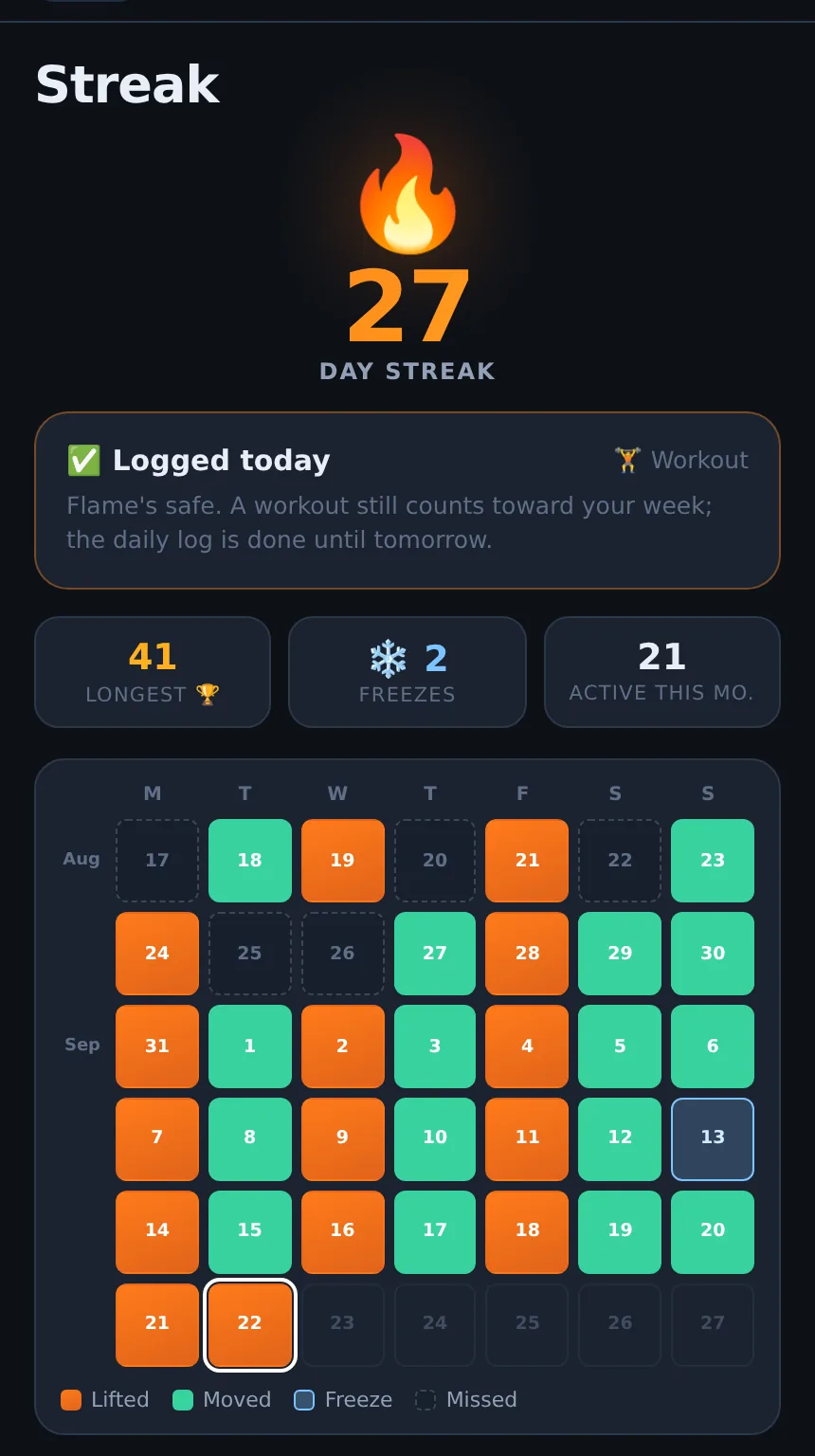
A streak built exactly this way
Liftspan's daily streak is this whole guide in one screen. Log anything you did today, a walk, yoga, a bike ride, or "something else," and your flame stays lit. Lifting days count on their own. A full training week earns you a freeze for the day life gets in the way, and you can keep a shared streak with a friend who sees whether you showed up and nothing else. The daily streak is free, and it always will be.
Common questions
How long does it take to build an exercise habit?
Longer than the 21 days you often hear. In a UCL study of people building a new daily habit, the median time to automaticity was 66 days, with a range of 18 to 254. For gym exercise specifically, a study of new members found that training at least four times a week for about six weeks built the habit, with consistency the biggest predictor.
Does walking count as exercise for a habit?
Yes. For building the habit, what matters is doing something every day, and a walk is the easiest thing to repeat. Brisk walking also counts toward the CDC's 150 minutes a week of moderate activity. Add strength training two or more days a week on top of it.
What should I do if I miss a day?
Nothing dramatic. In the research, missing a single day did not meaningfully set back habit formation. The risk is missing the second day. Make the day after a miss the easiest possible version of your habit, even five minutes, to keep the pattern going.
Should I work out every day?
Move every day, train hard a few times a week. Daily walking or mobility builds the habit without piling up fatigue. Strength training two or three times a week, with rest in between, is where you get stronger, especially after 40 when recovery matters more.
Sources: Lally et al. 2010, How are habits formed (European Journal of Social Psychology) · Kaushal & Rhodes 2015, Exercise habit formation in new gym members (Journal of Behavioral Medicine) · Gollwitzer & Sheeran 2006, Implementation intentions meta-analysis · Carron, Hausenblas & Mack 1996, Social influence and exercise (Journal of Sport and Exercise Psychology) · CDC physical activity guidelines for adults. General information, not a substitute for a clinician.
Keep reading: the science of training after 40 · lifting with a bad shoulder · how many days a week to lift after 40 · all guides