Trap Bar Deadlift: How to Do It, Muscles Worked, and Trap Bar vs Deadlift
The trap bar deadlift (also called the hex bar deadlift) is a deadlift where you stand inside a hexagon-shaped bar and lift by the side handles. The weight sits in line with your body instead of in front of it, so you stay more upright, your legs do more of the work, and research shows lower peak load on your lower back than a straight bar. For most lifters, it is the best deadlift to learn first and the easiest one to keep doing for decades.
What is a trap bar deadlift?
A trap bar is a six-sided frame with a handle on each side. You step into the middle, grab the handles with your palms facing in, and stand up with it. Because your hands are at your sides rather than in front of your shins, you can keep your chest higher and bend your knees more. That makes it a cross between a deadlift and a squat: still a hip hinge, with more help from the legs.
Most bars have two sets of handles. The high handles shorten the distance you pull, which is useful if your hips are stiff or your back is touchy. The low handles give a full deadlift range. Start with the high ones and move down when the lift feels smooth.
How to do a trap bar deadlift
- Step into the center. Stand in the middle of the bar with your feet about hip width apart, so the handles line up with the middle of your feet.
- Grip the handles. Push your hips back, bend your knees and grab the middle of each handle. Off-center grips tip the bar.
- Set your back and brace. Chest up, back flat, eyes forward. Take a big breath into your belly and tighten your stomach as if bracing for a poke.
- Push the floor away. Drive through your whole foot and stand up, hips and shoulders rising together. Finish tall, with your glutes squeezed. Don't lean back.
- Lower under control. Push your hips back and bend your knees to bring the bar straight down. Set it down, reset your breath and brace before the next rep.
Muscles worked
The trap bar deadlift trains the quadriceps, glutes and hamstrings, with the lower back, upper back, traps and forearms working hard to hold your position and your grip. Compared with a straight bar, it shifts the work toward the front of the thighs. A 2016 study by Camara and colleagues measured more quadriceps activity with the trap bar, and more hamstring and lower back activity with the straight bar.
Trap bar deadlift vs deadlift
Two studies of experienced lifters compared them head to head:
| Trap bar deadlift | Straight bar deadlift | |
|---|---|---|
| Load on the lower back | Lower peak load on the lumbar spine (Swinton 2011) | Higher |
| Load on the knees | Higher | Lower |
| Main muscles | More quads | More hamstrings and lower back (Camara 2016) |
| Speed and power | Higher peak power and bar speed in both studies | Lower |
| Max weight | About 8% more in Swinton's 19 powerlifters; no difference in Camara's 20 lifters | Same or slightly less |
| Learning curve | Easier: the bar path is simple and you can't drift it forward | Harder: keeping the bar close takes practice |
Neither is better for everyone. If you compete in powerlifting, you need the straight bar. If you want strong legs and hips with less strain on your back, and an easier lift to coach yourself through, the trap bar wins. Many lifters keep both: trap bar for most training, straight bar now and then.
Is the trap bar deadlift easier on your back?
Easier, not free. The research shows lower peak load on the lower back than a straight bar, and the upright position makes it harder to round your back by accident. It is still a heavy lift from the floor, though, and your lower back still holds your trunk in place. Liftspan rates it as a lift that uses the lower back, the same way it rates every loaded deadlift.
If your back is sore, start with the high handles, use a weight you could lift 10 times for sets of 5, and build up over weeks. If your knees are the problem rather than your back, the trap bar loads them more, so a Romanian deadlift or hip thrust may suit you better.
Common mistakes
- Squatting it. Hips too low, chest too high, and the lift turns into a squat. Push your hips back first.
- Standing off-center. If the front or back of the bar tips, you are not in the middle. It pulls you forward or back on every rep.
- Leaning back at the top. Stand tall and squeeze your glutes. Leaning back adds nothing and pinches the lower back.
- Bouncing reps. Set the bar down and brace again each rep. Most tweaks happen on a rushed, unbraced rep.
- Jumping the weight. Because it feels easier than a straight bar, people load it fast. Tendons adapt slower than muscles, especially after 40.
Sets, reps and weight
For most lifters, 3 sets of 5 to 8 reps, once or twice a week, with one or two reps left in the tank at the end of each set. Start lighter than you think, with a weight that feels easy for 8. When you can do all your sets at the top of the rep range with good form, add the smallest step your gym has. That is double progression, and it is how Liftspan moves your weight up.
It fits in the hinge slot of a 3 day full body workout or on the lower days of an upper lower split. Don't put it on the day after heavy squats.
Trap bar deadlift alternatives
| No trap bar, or it bothers you? | Try |
|---|---|
| No trap bar in your gym | Dumbbell deadlift with the dumbbells at your sides: the same position, lighter |
| Lower back flares up | Barbell hip thrust: big hip work with your back supported. It is the swap Liftspan offers |
| Knees complain | Romanian deadlift: knees stay nearly straight, the hamstrings do the work |
| Training at home | Kettlebell deadlift from a box, building up to heavier bells |
A 3 day trap bar deadlift plan
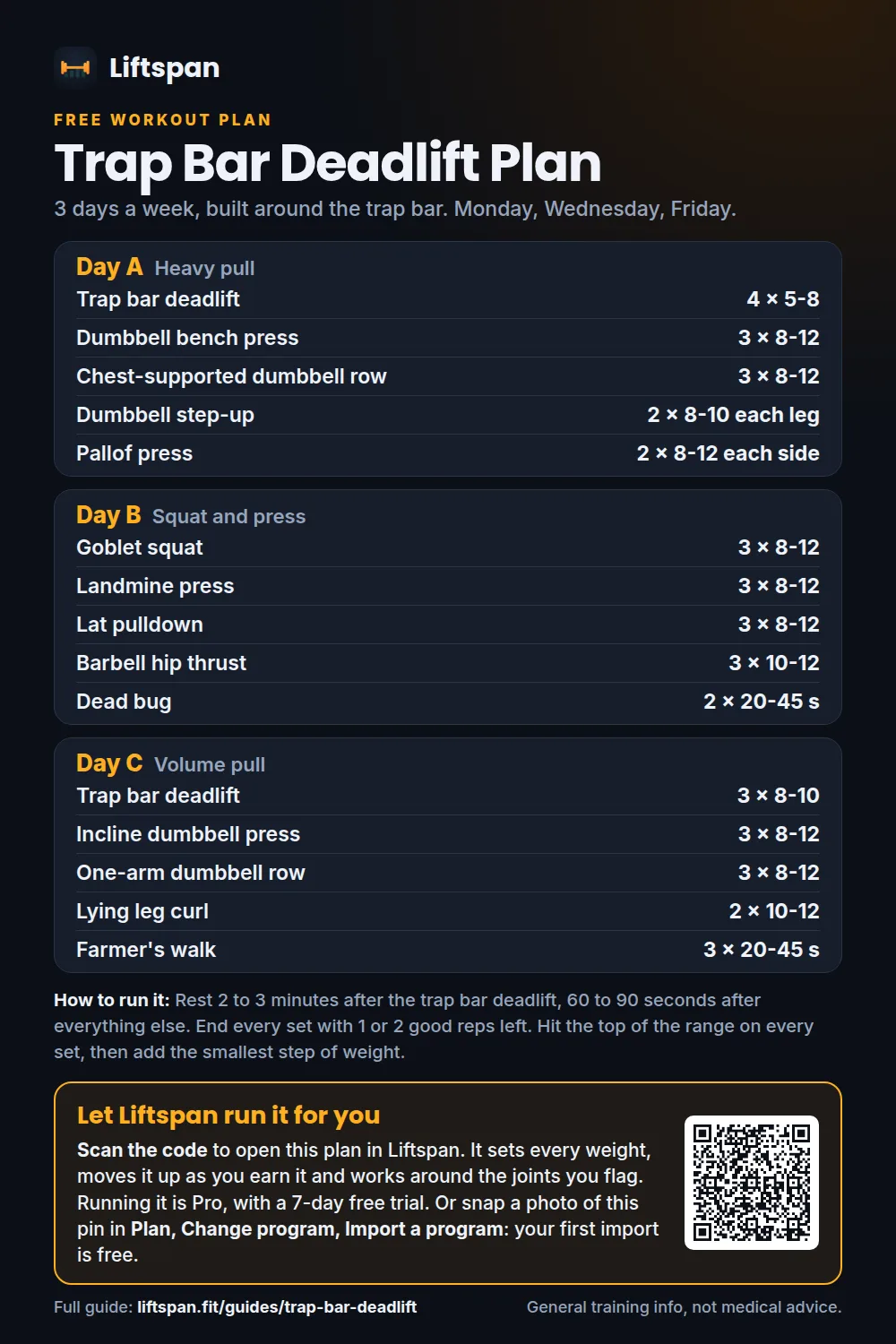
Here is a full week built around the lift: heavy trap bar deadlifts on day A, lighter sets for more reps on day C, with presses, rows, squats and core work around them. Run it Monday, Wednesday and Friday.
| Day | Exercise | Sets x reps |
|---|---|---|
| Day A Heavy pull | Trap bar deadlift | 4 x 5-8 |
| Dumbbell bench press | 3 x 8-12 | |
| Chest-supported dumbbell row | 3 x 8-12 | |
| Dumbbell step-up | 2 x 8-10 each leg | |
| Pallof press | 2 x 8-12 each side | |
| Day B Squat and press | Goblet squat | 3 x 8-12 |
| Landmine press | 3 x 8-12 | |
| Lat pulldown | 3 x 8-12 | |
| Barbell hip thrust | 3 x 10-12 | |
| Dead bug | 2 x 20-45 s | |
| Day C Volume pull | Trap bar deadlift | 3 x 8-10 |
| Incline dumbbell press | 3 x 8-12 | |
| One-arm dumbbell row | 3 x 8-12 | |
| Lying leg curl | 2 x 10-12 | |
| Farmer's walk | 3 x 20-45 s |
Rest 2 to 3 minutes after the trap bar deadlift, 60 to 90 seconds after everything else. End every set with 1 or 2 good reps left. Hit the top of the range on every set, then add the smallest step of weight.
Trap bar deadlifts, coached
Open this plan in Liftspan and it is ready to go: every move fitted to your gym and to any joint you flag, every weight filled in and moved up as you earn it, and a lighter deload week at the end of each block. Running it is Pro, with a 7-day free trial. Rather use paper? Print the sheet, or snap a photo of it in Liftspan: your first import is free.
Common questions
Is the trap bar deadlift better than a regular deadlift?
It depends on your goal. The trap bar puts less peak load on your lower back, lets most people move the bar faster, and is easier to learn. The straight bar works the hamstrings and lower back more and is the one used in powerlifting. For general strength after 40, the trap bar is the better starting point for most people.
What muscles does the trap bar deadlift work?
Mainly the quadriceps, glutes and hamstrings, with the lower back, upper back, traps and forearms working to hold your position and grip. It works the quads more than a straight bar deadlift does.
Is the trap bar deadlift a squat or a deadlift?
A deadlift, but with more knee bend than a straight bar deadlift, so it sits between the two. It is still a hip hinge: push your hips back first, then stand up.
Should I use the high or low handles?
Start with the high handles if your hips are stiff or your back is sensitive, because they shorten the pull. Move to the low handles for a full range once the lift feels smooth.
Can you lift more with a trap bar?
Some lifters can. One study of powerlifters found they lifted about 8% more with a trap bar, while another study of trained men found no difference. Either way, compare yourself to your own trap bar numbers, not your straight bar ones.
Using Liftspan? See how Liftspan works around your lower back in the help manual. New to it? Liftspan is a strength training app that builds your plan around your joints and moves the weight for you.
Sources: Swinton et al. 2011, A biomechanical analysis of straight and hexagonal barbell deadlifts (Journal of Strength and Conditioning Research); Camara et al. 2016, An examination of muscle activation and power characteristics while performing the deadlift exercise with straight and hexagonal barbells (Journal of Strength and Conditioning Research). General information, not a substitute for a clinician.
Keep reading: deadlift lower back pain · 3 day full body workout · all guides